What Is the CSGO Drop System?
The CSGO drop system is a built-in reward mechanism that gives players free items simply for playing the game. Every time you finish a competitive match, casual game, or other official game mode, there is a chance you will receive a random item drop at the end of the round. These drops include weapon skins, weapon cases, graffiti sprays, and other cosmetic items that you can use, trade, or sell on the Steam Community Market.
Valve designed the drop system to reward regular play and keep the in-game economy healthy. While the items you receive from drops are typically not the most valuable skins available, they offer a consistent way for players to build up their inventory without spending any real money. Understanding how the system works can help you get the most out of your time in CSGO.
How Do CSGO Drops Work?
CSGO drops are awarded at the end of matches on official Valve servers. The system evaluates each player at the conclusion of a game and determines whether or not to grant a drop. There are several key factors that influence when and how drops are distributed.
End-of-Match Drops
After every match on an official Valve server, the game randomly selects players to receive item drops. You will see a notification on the scoreboard screen showing which players received drops and what items they got. These drops are entirely random -- you cannot influence which specific item you will receive. The items are automatically added to your Steam inventory.
It is important to note that you must complete the match to be eligible for drops. Abandoning a match or getting kicked will disqualify you from receiving an end-of-match drop for that game. Playing the match to completion, regardless of the outcome, keeps you in the drop pool.
The Weekly Reset and XP System
CSGO uses a weekly XP reset that directly ties into the drop system. Every week (resetting on Tuesday nights), your XP multiplier is refreshed. When you first start playing after the reset, you earn XP at an accelerated rate. As you accumulate more XP throughout the week, the multiplier gradually decreases, reducing the rate at which you earn experience points.
This weekly cycle is crucial because drops are tied to your XP progression. Each time you rank up your profile level (by earning enough XP), you receive a drop. After the weekly reset, the boosted XP rate means you can rank up faster and receive your weekly drop more quickly.
Profile Rank and Service Medal
Your profile rank goes from 1 to 40. Once you reach rank 40, you have the option to reset your rank back to 1 and receive a Service Medal for that year. Service Medals are displayed on your profile and serve as a badge of dedication. The more times you reset within a year, the higher the tier of your Service Medal becomes, changing its color and appearance.
Types of CSGO Drops
The CSGO drop system can award several different categories of items. Here is a breakdown of each type and what you can expect.
Weapon Skin Drops
Weapon skins are the most sought-after drops in CSGO. These cosmetic items change the appearance of your weapons in-game. Dropped weapon skins come from specific collections that rotate over time. The skins you receive from drops are typically from older collections and tend to be of lower rarity (Consumer Grade or Industrial Grade), though occasionally you may receive a higher-rarity skin.
Some of the collections that have historically been available in the drop pool include:
- The Dust 2 Collection -- skins associated with the iconic Dust II map
- The Mirage Collection -- skins tied to the popular Mirage map
- The Inferno Collection -- weapon finishes themed around Inferno
- The Nuke Collection -- skins from the Nuke map pool
- The Train Collection -- finishes associated with the Train map
- The Vertigo Collection -- skins tied to the Vertigo map
- The Overpass Collection -- weapon skins from Overpass
- The Cache Collection -- skins themed around Cache
While most dropped skins are worth only a few cents on the Steam Market, rare drops from certain collections can be worth significantly more. Occasionally, a high-rarity drop from a sought-after collection can be worth several dollars or even more.
Weapon Case Drops
Weapon cases are one of the most common drops in CSGO. These locked containers require a key (purchased from the in-game store or Steam Market for approximately $2.49 USD) to open. Each case contains a set of possible weapon skins, ranging from common Mil-Spec items to extremely rare Covert or Knife skins.
Cases that commonly drop include both newer and older releases. Some of the cases that have been in the active drop pool include:
- Revolution Case
- Recoil Case
- Dreams & Nightmares Case
- Snakebite Case
- Fracture Case
- Prisma 2 Case
- Danger Zone Case
- Clutch Case
- Spectrum 2 Case
Valve periodically updates the pool of cases that can drop, adding new cases and sometimes removing older ones. When a case is removed from the active drop pool, its supply decreases over time, which can cause its market value to increase significantly. Cases like the Bravo Case and Operation Breakout Case became quite valuable after being removed from the drop pool.
Graffiti Drops
Graffiti sprays are cosmetic items that let you spray a design on walls, floors, and other surfaces during a match. Graffiti drops come in sealed form, and each sealed graffiti can be applied 50 times before it runs out. Unlike weapon skins, graffiti items are generally low in value, but they add a fun element of personalization to your gameplay.
Graffiti can range from simple patterns and symbols to character art and community-designed sprays. While they may not be worth much financially, collecting different graffiti designs is part of the CSGO experience for many players.
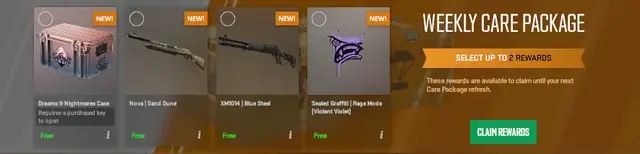
The Weekly Care Package Explained
The Weekly Care Package is a special drop that every CSGO player is eligible to receive once per week. This is separate from the random end-of-match drops and is directly tied to the XP system and your profile rank progression.
How to Earn Your Weekly Care Package
To receive your Weekly Care Package, you need to earn enough XP during the week to rank up your profile level at least once. Here is how the process works step by step:
- Play matches on official servers -- competitive, casual, deathmatch, Arms Race, Demolition, or any other official game mode will earn you XP.
- Accumulate XP -- every round you play earns you experience points. The amount varies by game mode, with competitive matches generally awarding the most XP.
- Rank up your profile -- once you earn enough XP to fill your rank bar and level up, you receive your Weekly Care Package drop.
- Receive your item -- the drop is automatically added to your inventory. You will see a notification on-screen when you level up.
After you receive your first rank-up drop for the week, subsequent rank-ups will not grant additional drops until the following weekly reset. This means you effectively get one guaranteed drop per week from the Care Package system, plus any additional random end-of-match drops.
What Can You Get from the Weekly Care Package?
The Weekly Care Package can contain the same types of items as regular drops: weapon skins from active collections, weapon cases, and graffiti. However, the Weekly Care Package is your best chance each week at receiving a weapon skin rather than just a case or graffiti. Many players report that their most valuable free drops came from the Weekly Care Package.
Prime Status vs. Non-Prime Drops
One of the most significant factors affecting your drop experience in CSGO is whether or not you have Prime Status. Prime Status was originally earned by reaching profile rank 21 or by linking a phone number, but Valve later changed it to a paid upgrade.
Prime Status Benefits for Drops
- Eligible for weapon skin drops -- Prime players can receive weapon skins from active map collections as drops
- Eligible for weapon case drops -- Prime players receive cases that can be sold or opened
- Weekly Care Package -- Prime players receive their weekly guaranteed drop when they rank up
- Better matchmaking -- Prime players are matched with other Prime players, resulting in generally better match quality
- XP earnings -- Prime players earn XP at a standard rate, allowing them to rank up and receive drops
Non-Prime Limitations
After Valve made CSGO free-to-play in December 2018, non-Prime players faced significant restrictions on the drop system:
- No weapon skin drops -- non-Prime players cannot receive weapon skins from the drop system
- No case drops -- weapon cases are not dropped for non-Prime accounts
- Limited to graffiti -- non-Prime players can only receive graffiti items as drops
- No Weekly Care Package -- the care package system is exclusive to Prime players
- Reduced XP rate -- non-Prime players earn XP at a reduced rate
For players who are serious about building an inventory through drops, upgrading to Prime Status is essentially a requirement. The investment unlocks the full drop system and gives you access to items that have actual market value.
How to Maximize Your CSGO Drops
While you cannot control exactly what items you receive, there are several strategies you can use to maximize the number and quality of drops you get over time.
1. Play Every Week After the Reset
The most important thing you can do is play at least a few matches every week after the Tuesday reset. Your boosted XP multiplier means you will rank up quickly after the reset, securing your Weekly Care Package with minimal time investment. Even just two or three competitive matches can be enough to earn your weekly drop.
2. Focus on XP-Efficient Game Modes
Not all game modes are created equal when it comes to XP earnings. Here is a general ranking of game modes by XP efficiency:
- Competitive Matchmaking -- highest XP per match, especially if you win
- Wingman -- good XP for shorter matches
- Casual -- moderate XP, shorter time commitment
- Deathmatch -- consistent XP, no match outcome dependency
- Arms Race / Demolition -- lower XP, but quick matches
If your goal is purely to earn drops as efficiently as possible, competitive matchmaking gives you the best return on your time. However, if you prefer a more relaxed experience, casual and deathmatch are perfectly viable options that still earn you meaningful XP.
3. Have Prime Status
As discussed earlier, Prime Status is essential for accessing the full drop system. Without it, you are limited to graffiti drops, which have negligible market value. If you plan to play CSGO regularly, upgrading to Prime is the single most impactful thing you can do for your drop potential.
4. Complete Operation Missions (When Available)
When Valve releases an Operation (such as Operation Riptide or Operation Broken Fang), participating in the Operation missions provides additional drop opportunities beyond the standard system. Operations typically include their own exclusive weapon collections and special rewards that are not available through regular drops.
5. Do Not Idle for Drops
Valve implemented anti-idle measures in CSGO. Simply joining a server and going AFK will not earn you meaningful XP or drops. You need to actively participate in matches to accumulate the XP required for rank-ups and drops. Idle farming is not an effective strategy and can result in penalties.
Understanding XP and Its Connection to Drops
Experience points (XP) are the backbone of the CSGO drop system. Here is a deeper look at how XP works and how it directly connects to your drops.
XP Multiplier Breakdown
At the start of each week, your XP multiplier is at its highest. As you earn XP throughout the week, the multiplier decreases through several tiers:
- Bonus XP (4x multiplier) -- the first tier after the weekly reset, giving you four times the normal XP rate
- Boosted XP (2x multiplier) -- after exhausting the bonus tier, you still earn double XP
- Standard XP (1x multiplier) -- the base rate of XP earnings
- Reduced XP (0.5x multiplier and below) -- after earning a significant amount of XP in a week, the rate drops to discourage excessive grinding
The reduced multiplier is sometimes referred to as the "XP cooldown." It is Valve's way of spreading player activity across the week rather than encouraging marathon sessions. From a drop perspective, this means your most efficient play time is right after the weekly reset when XP multipliers are at their highest.
How Much XP Do You Need to Rank Up?
Each profile rank requires approximately 5,000 XP to advance to the next level. With the boosted multiplier active after a weekly reset, you can earn this in as few as two to three competitive matches if you perform well and win. Without the boost, it may take significantly more matches to earn the same amount.
Which Cases Can Drop in CSGO?
Valve maintains two categories of cases in the drop system: Active Drop Pool cases and Rare Drop Pool cases.
Active Drop Pool
The Active Drop Pool contains the newest cases that Valve has released. These cases drop frequently and are the most common case drops you will receive. When a new case is released, it typically replaces the oldest case in the Active Drop Pool. Because these cases drop regularly, they tend to have lower market prices due to high supply.
Rare Drop Pool
The Rare Drop Pool contains older cases that are no longer in the active rotation but can still occasionally drop. These drops are much less frequent, which means the cases in this pool tend to have higher market values due to limited supply. Some notable cases in the Rare Drop Pool include:
- CS:GO Weapon Case -- one of the original CSGO cases
- eSports 2013 Case -- an early tournament-themed case
- Operation Bravo Case -- from the first CSGO operation
- Chroma Case / Chroma 2 Case -- popular older cases
- Gamma Case / Gamma 2 Case -- known for unique knife finishes
- Spectrum Case -- featuring colorful weapon skins
- Glove Case -- introduced glove skins to the game
Receiving a Rare Drop Pool case is a pleasant surprise and can be more valuable than receiving an Active Drop Pool case. However, the odds of getting a rare pool case are significantly lower than receiving a case from the active pool.
Tips for Managing Your Dropped Items
Once you start accumulating drops, it helps to have a strategy for managing your inventory.
Sell or Hold?
One common question is whether you should sell items immediately or hold onto them. Here are some general guidelines:
- Cases from the Active Drop Pool -- these tend to be cheap because they are dropping for many players. Consider holding them for several months or even years, as discontinued cases tend to appreciate in value once they leave the active pool.
- Weapon skins -- if you receive a skin you do not plan to use, selling it on the Steam Market is a straightforward way to add funds to your Steam Wallet.
- Graffiti -- graffiti drops typically have very low market value. You may prefer to simply use them in-game rather than selling them for a few cents.
- Rare Drop Pool cases -- these often already have a higher value. Check the current market price before deciding whether to sell or hold.
Trading Drops for Better Items
You can also use your accumulated drops as trading material. While individual drops may not be worth much, combining the value of many drops over time can allow you to trade up to more desirable items. The buy and sell CSGO skins securely guide covers the best practices for trading safely.
Frequently Asked Questions
Can I get a knife from a drop?
No, knives and gloves cannot be obtained directly from the drop system. They can only be unboxed from weapon cases. The drop system is limited to weapon skins from active collections, weapon cases, and graffiti.
Do I need to win the match to get a drop?
No, you do not need to win the match. Drops are awarded randomly at the end of completed matches regardless of whether you won or lost. However, winning competitive matches does give you more XP, which helps you rank up faster for your Weekly Care Package.
Can I get drops on community servers?
No. Drops are only awarded on official Valve servers. Community servers, regardless of the game mode, do not award drops or contribute XP toward your profile rank. You must play on official matchmaking, casual, deathmatch, or other Valve-hosted game modes.
How many drops can I get per week?
There is no hard cap on the number of random end-of-match drops you can receive, but the Weekly Care Package (rank-up drop) is limited to one per week. In practice, most players receive one to three drops per week from a combination of end-of-match drops and the Weekly Care Package.
Do Overwatch XP rewards count toward drops?
Yes, XP earned from participating in the Overwatch system (reviewing reported players for cheating or griefing) counts toward your profile rank progression. If this XP causes you to rank up, you will receive your Weekly Care Package drop just as you would from match XP.
Conclusion
The CSGO drop system is a reliable way to build your inventory over time without spending money. By understanding how the weekly XP reset works, maintaining Prime Status, and playing efficiently after each Tuesday reset, you can maximize the value you get from free drops. While you are unlikely to receive a rare or expensive item from a single drop, consistent weekly play adds up over months and years, providing you with cases that may appreciate in value and weapon skins to use or trade.
Whether you are a casual player looking to collect a few free skins or a dedicated trader trying to build your inventory from the ground up, the drop system rewards regular engagement. Make sure to check in each week, play a few matches after the reset, and claim your Weekly Care Package -- it is the easiest free loot in CSGO.